Do I Need RAMS for a Small Domestic Job?
Confused about whether you need a Risk Assessment and Method Statement for small domestic work? Here's the plain-English answer.
4 min read
TL;DR
There is no single CDM rule that says every small domestic job must have a document called RAMS. But employers and self-employed contractors still need to assess and control the risks. In practice, write RAMS when the job has real hazards, when a client or principal contractor asks for them, or when you need clear written proof of how the work will be done safely.
What Are RAMS?
RAMS stands for Risk Assessment and Method Statement. It's a combined document that:
- Lists the hazards involved in a job
- Describes the steps you'll take to control those risks
- Sets out the sequence of work so everyone knows what they're doing
You've probably seen them on bigger sites. But they're just as useful on a two-person domestic job.
When Are RAMS Legally Required?
Under CDM 2015, there's no hard threshold that says "jobs over X days need RAMS." But the rules do apply broadly:
- All construction work has a duty to manage health and safety
- If you employ anyone (including subcontractors), you have a legal duty to assess and control risks
- For notifiable projects (those lasting more than 30 working days with more than 20 workers simultaneously, or exceeding 500 person-days), a full Construction Phase Plan is required — RAMS feed into that
So on a small domestic job with just you and a mate? No one's going to knock on your door and ask for a RAMS document. But if something goes wrong and it ends up in front of the HSE, having written evidence that you thought about the risks will work strongly in your favour.
The Practical Reason to Write RAMS Anyway
Beyond legal cover, there's a simple business reason: clients are increasingly asking for them.
Homeowners doing an extension often have insurance policies or mortgage lenders requiring contractors to have documented risk assessments. Letting agents and estate managers almost always ask. If you can produce a clean RAMS document in 10 minutes, you look professional and you win jobs.
What Should a RAMS Include for Domestic Work?
Even for smaller jobs, a good RAMS covers:
- Job description — what you're doing, where, when
- Key hazards — working at height, dust, electrical, manual handling, confined spaces if relevant
- Control measures — PPE, safe systems of work, segregation from occupants
- Sequence of work — how the job will be done, step by step
- Emergency arrangements — first aid, site contacts, nearest A&E
You don't need a 20-page document for a bathroom refit. A two-page RAMS is fine. The point is that you've thought it through.
The Bottom Line
You're not always legally required to produce RAMS for small domestic work. But:
- It protects you if something goes wrong
- It helps you win jobs from professional clients
- It takes 10 minutes with the right tool
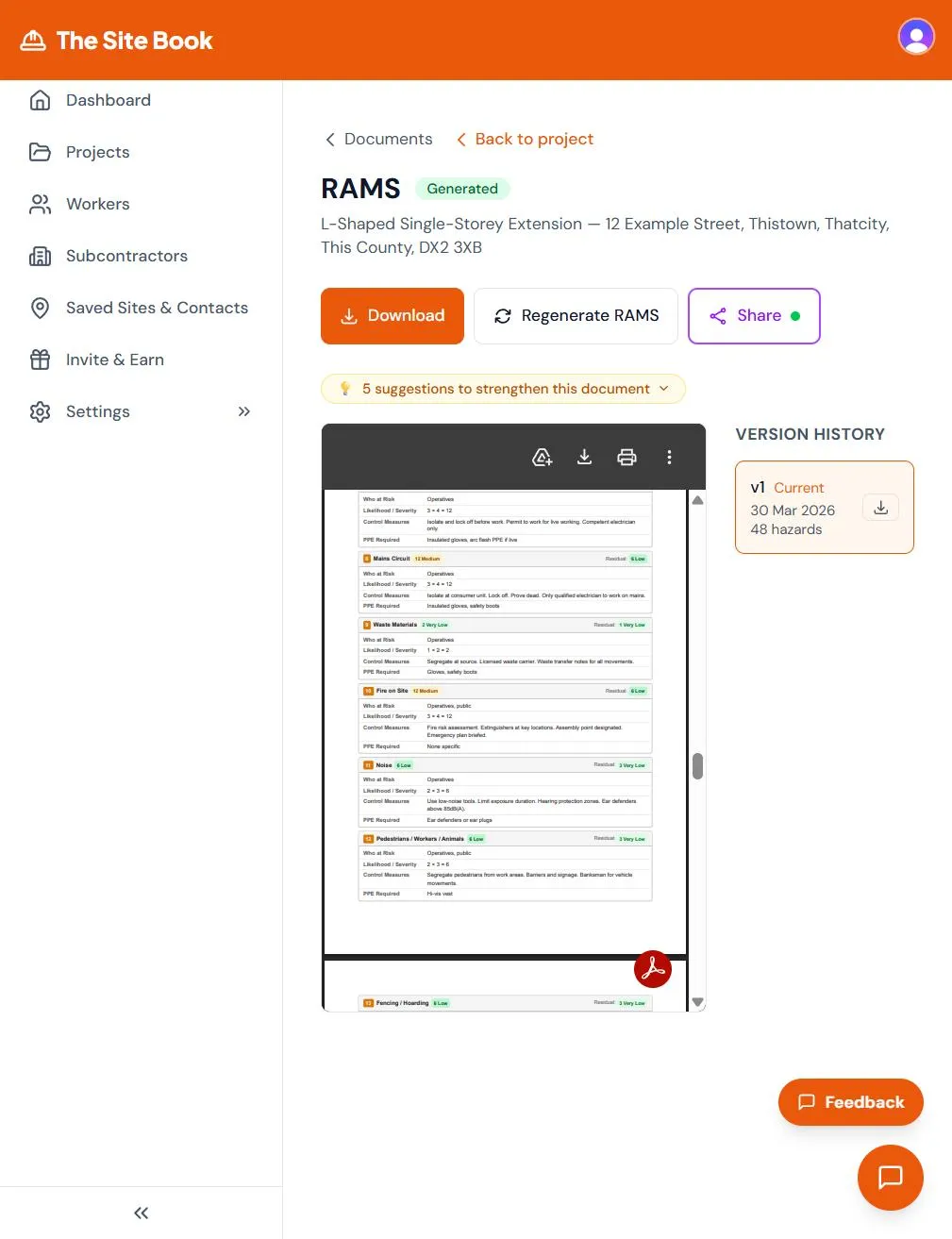
The Site Book generates RAMS in minutes — just answer a few questions about your job and it handles the rest. Try it free →
Ready to sort your compliance?
The Site Book handles RAMS, CPP, site inductions, and everything else. All in one place.
Try The Site Book →