Do I Need RAMS for Domestic Work?
When is a RAMS required for domestic construction projects? A clear guide to CDM 2015 requirements for small builders, sole traders, and domestic clients.
6 min read
TL;DR
When is a RAMS required for domestic construction projects? A clear guide to CDM 2015 requirements for small builders, sole traders, and domestic clients.
The Short Answer
Technically, no. CDM 2015 defines domestic clients differently from commercial ones, and the full CDM duties don't apply to purely domestic work in the same way. But that doesn't mean you should skip writing a RAMS for domestic jobs.
The Health and Safety at Work Act 1974 (HASAWA) applies to all work activities, domestic or not. If you're a contractor working on someone's house, you still have a legal duty to plan your work safely and protect anyone who might be affected — that includes the homeowner, their family, neighbours, and passers-by.
What Exactly is a RAMS?
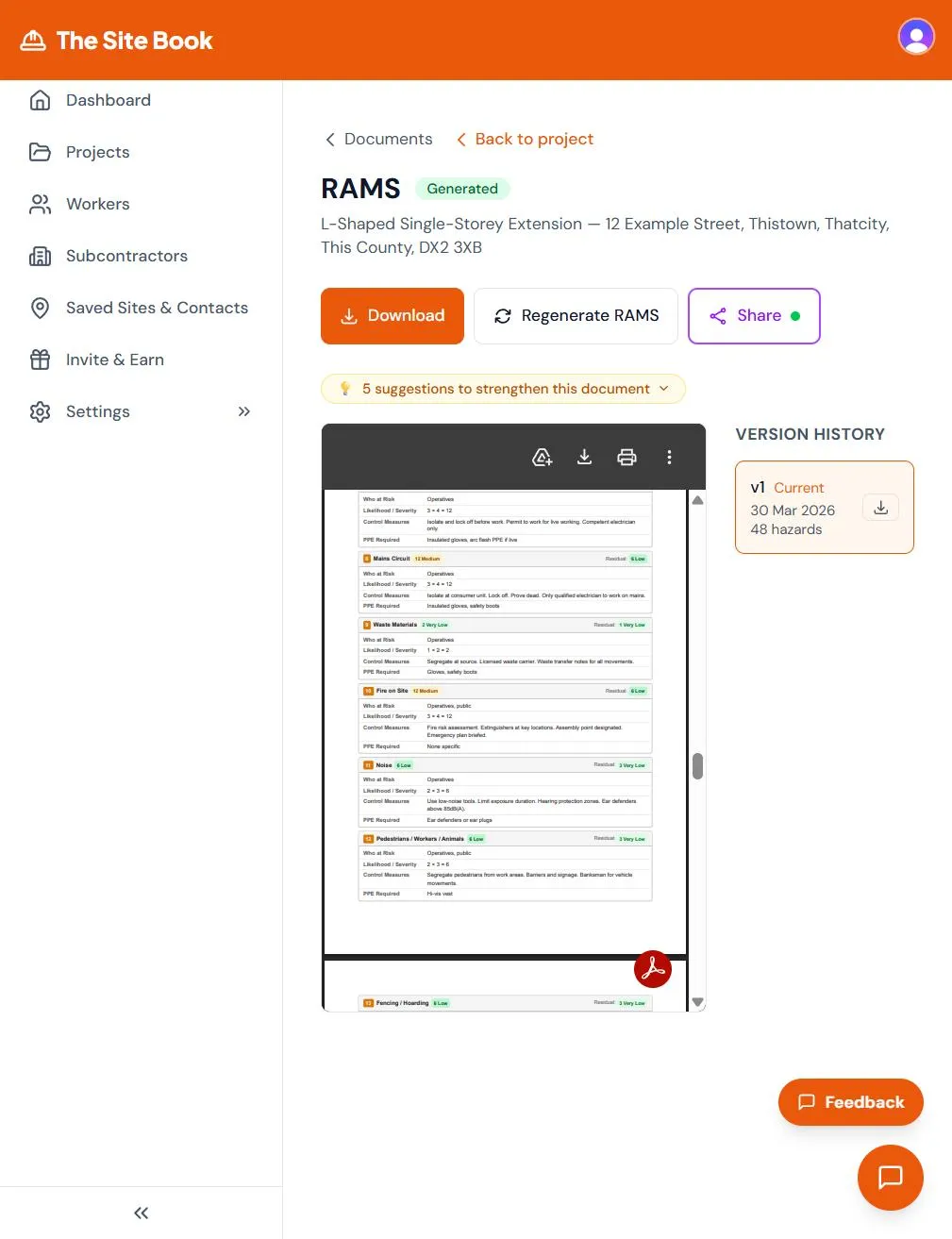
RAMS stands for Risk Assessment and Method Statement. It's a single document (or sometimes two separate documents) that covers two things: identifying what could go wrong on a job (the risk assessment), and describing how you'll do the work safely (the method statement).
The risk assessment lists each hazard — working at height, electrical isolation, manual handling of heavy materials — and rates the likelihood and severity of each. The method statement then describes your step-by-step approach, including what control measures you'll put in place to reduce each risk. If you're unfamiliar with the format, read our full guide to what RAMS is and when you need one.
What CDM 2015 Says
Under CDM 2015, domestic clients (homeowners having work done on their own home) don't have to appoint a principal designer or principal contractor. But if you're a contractor working on a domestic project, you still have duties under CDM Regulation 15 — you must plan, manage, and monitor your own work to ensure it's carried out safely.
The domestic client's CDM duties automatically pass to the contractor (or the principal contractor if there are multiple contractors). So while the homeowner doesn't need to worry about CDM paperwork, you still do.
When You Should Write a RAMS
Even though a formal RAMS isn't legally mandated for every domestic job, there are clear situations where not having one is asking for trouble:
- Any job involving working at height — roof work, loft conversions, external painting above ground floor
- Structural work — removing walls, installing steels, underpinning foundations
- Work near existing services — gas pipes, electrical cables, water mains, drainage
- Excavation work — foundations, drainage trenches, soakaways
- Work involving hazardous substances — asbestos disturbance, lead paint, solvents, dust
- Hot works — soldering, welding, torch-on felt roofing near combustible materials
- Jobs where members of the public could be affected — work near pavements, shared access, party walls
Real Examples: When Domestic Work Needs a RAMS
Here are five common domestic jobs where writing a RAMS isn't just good practice — it's essential for protecting yourself, your workers, and the homeowner.
Loft conversion in a 1930s semi. You're installing structural steel at height, working in a confined roof space, and disturbing insulation that may contain asbestos. The combination of working at height, heavy manual handling of steel beams, and potential asbestos exposure means you need a clear plan before anyone steps on a ladder.
Kitchen extension with foundations. Excavation near existing drainage and underground services creates risks of collapse, service strikes, and flooding. Add in temporary structural support for the existing wall opening, concrete pours, and steel beam installation — each activity has its own hazards that need documenting.
Bathroom renovation involving gas work. Relocating a boiler means working with gas pipework (Gas Safe registration required), hot water systems under pressure, and potentially working in a confined airing cupboard. Plumbing work also involves manual handling of heavy items like cast iron baths and ceramic sanitaryware.
Re-roofing a bungalow. Even a single-storey roof means working at height with edge protection or scaffolding. Old roof coverings may include fragile materials like asbestos cement sheets. Manual handling of tiles at height adds complexity — a stack of concrete roof tiles weighs hundreds of kilograms.
Garden wall demolition near a public footpath. Demolishing a brick wall next to a pavement means managing public protection, dust suppression, manual handling of masonry, and potentially dealing with unstable sections that could collapse unexpectedly. If a passer-by is injured, having no risk assessment makes your position indefensible.
What Should Your Domestic RAMS Include?
Whether you're working on a mansion or a maisonette, a proper RAMS should cover:
- Job description and location — what you're doing and exactly where
- Hazards identified — specific to the trade and the site, not generic lists
- Risk ratings — likelihood multiplied by severity for each hazard
- Control measures — what you'll do to reduce each risk to an acceptable level
- PPE requirements — which personal protective equipment is needed and when
- Emergency procedures — what happens if something goes wrong
- Who's responsible — named persons for supervision and safety
- Review date — when the document should be reviewed or updated
For a detailed breakdown of each section, see our step-by-step guide to writing RAMS.
What About Insurance?
Most public liability and employer's liability insurers expect you to have risk assessments in place. If there's an incident on a domestic job and you can't show you assessed the risks beforehand, your insurer may refuse to pay out. That RAMS document could be the difference between a covered claim and a six-figure personal liability.
What Happens If Something Goes Wrong Without a RAMS?
If someone is injured on your job and HSE investigates, one of the first things they'll ask for is your risk assessment. Under HASAWA 1974, employers face unlimited fines on indictment, and even sole traders can face fines up to £20,000 in the magistrates' court plus potential imprisonment for serious breaches. HSE inspectors can visit any construction site, including domestic jobs — they don't need an invitation.
Beyond criminal prosecution, you face civil liability claims from anyone injured — workers, homeowners, neighbours, or members of the public. Without a documented risk assessment showing you identified hazards and put controls in place, it's extremely difficult to defend yourself. Your insurance company will almost certainly refuse to cover a claim if you had no risk assessment for the work that caused the injury.
The Practical Answer
You might not be legally required to write a formal RAMS for every domestic job under CDM 2015. But between HASAWA duties, insurance requirements, and the sheer cost of getting it wrong, the real question isn't "do I need one?" — it's "can I afford not to have one?"
A quick RAMS takes 10-15 minutes and covers you if anything goes sideways. On a domestic job where there's no principal contractor checking your paperwork, you're the one responsible. A RAMS is your proof that you took safety seriously.
FAQ
Is domestic work exempt from CDM 2015?
Domestic clients are treated differently under CDM 2015 — they don't have to appoint a principal designer or principal contractor. However, the Health and Safety at Work Act 1974 still applies to all work, and CDM duties transfer to the contractor automatically. For the full picture, read our guide to domestic client duties under CDM.
Do I need a CPP for a house extension?
A Construction Phase Plan isn't legally required for domestic-only projects. However, for anything involving structural work, multiple trades, or significant excavation, having a CPP is strongly recommended. It keeps everyone on the same page about sequencing, access, and safety. See our guide on CPPs for domestic extensions.
Can I just use a generic RAMS template?
You can start with a template, but generic templates miss job-specific hazards. A template for "general construction" won't cover the asbestos risk in a 1930s loft or the confined space in an airing cupboard. You must customise it for every job. For a comparison of approaches, read free RAMS template vs RAMS software.
How often should I update my RAMS?
Review your RAMS before each new job, even if it's similar to previous work. On longer projects, review it whenever site conditions change — new trades arriving, weather affecting ground conditions, or unexpected discoveries like buried services or asbestos. A RAMS is a living document, not a tick-box exercise.
Creating a proper RAMS doesn't have to take hours. With The Site Book, you describe your job and get a professional, site-specific RAMS in under 5 minutes.
Ready to sort your compliance?
The Site Book handles RAMS, CPP, site inductions, and everything else. All in one place.
Try The Site Book →